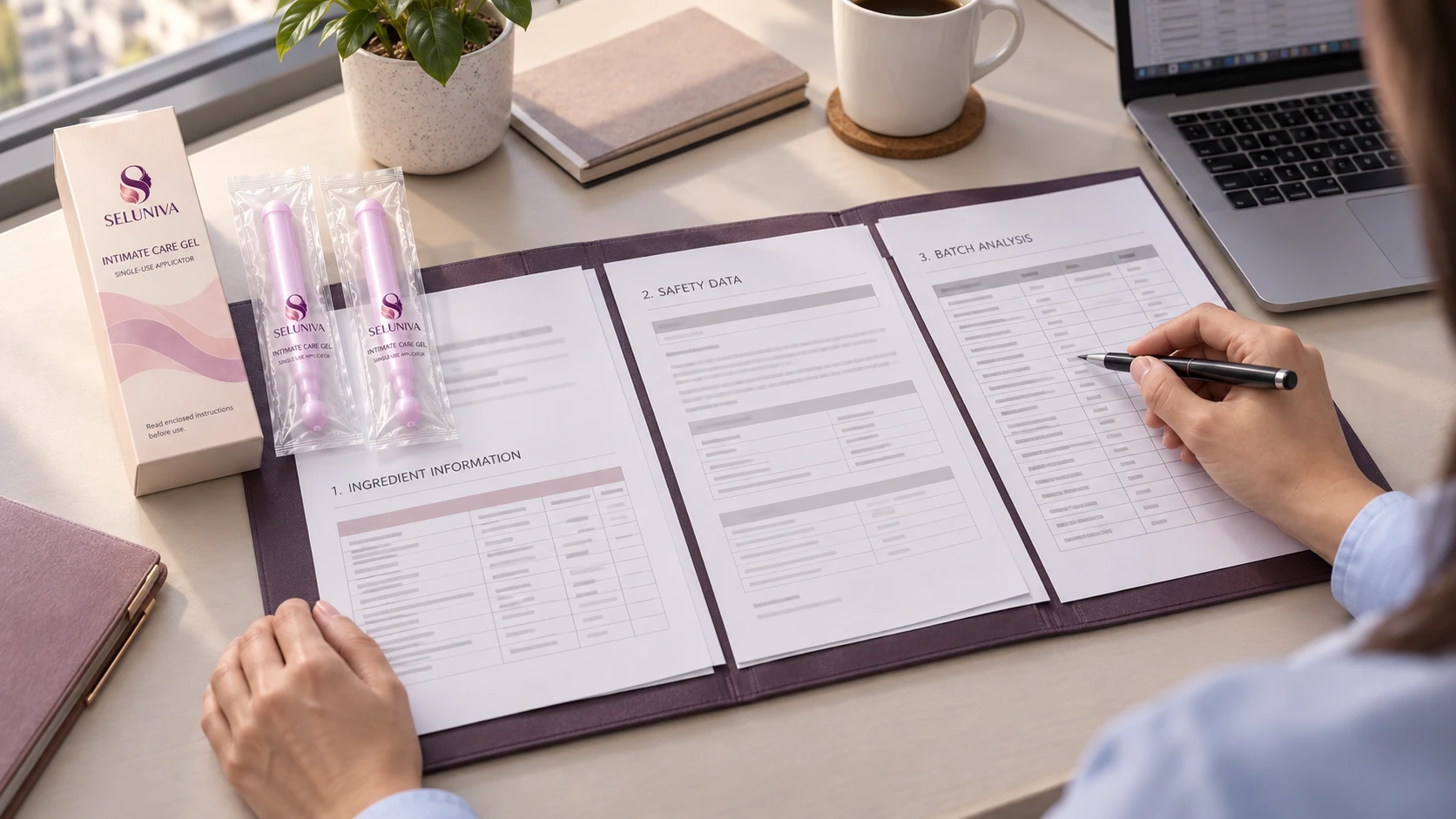
What exactly do procurement compliance documents for intimate care gels refer to?First, distinguish between product information, compliance documents, and market access documents.
When cross-border sourcing intimate care gels, suppliers send a stack of PDFs that often mix three completely different types of things. If you can't tell them apart, you'll run into pitfalls later when negotiating prices and discussing OEM.
What three types of documents are typically involved in a private-label vaginal tightening gel?
Product information: explains what the product itself is. For example, the formula contains plant extracts such as Sophora flavescens, net content 1g, origin Shaanxi, brand SELUNIVA, OEM/ODM customizable. This type of document answers "what does this product look like," not "can it be legally sold."
Compliance documents: explain whether the product meets the regulatory requirements of a certain market in terms of safety, ingredients, and production conditions. Intimate care gels are usually classified as cosmetics, medical devices, or feminine hygiene products, and different classifications correspond to different testing items and labeling rules. This type of document answers "can this product enter this market."
Market access documents: explain whether your company can sell it in this market. Involves importer qualifications, product registration or filing, label localization, etc. This type of document answers the question, "Can your company sell?".
The most common pitfall during procurement is treating product information as compliance documents—assuming that because the supplier provided an ingredient list and OEM instructions, the compliance issue is resolved. In reality, if any one of these three types of documents is missing, the goods may get stuck at customs or fail platform listing review.
Why "natural herbal" does not equal "no compliance documents required"
Natural herbal describes the source of ingredients, not a regulatory exemption. Ingredients such as Sophora flavescens and plant extracts are precisely key targets of scrutiny in many destination markets (the United States, Canada, Europe, Australia): some ingredients are permitted in cosmetics but with concentration limits, some require additional safety assessment in intimate-area products, and some cannot have functional claims such as "detox" or "womb wellness" on their labels.
In other words, the more "natural" the ingredients, the more documents are needed to prove their safety in intimate scenarios and label compliance—not the less effort required.
What to confirm nextAsk the current website team three things clearly: under what category this gel is declared in the target market, what testing or registration documents are already available, and whether the label copy can be adjusted for your market. Once you have these three answers, then decide whether to move on to the quotation and sampling stage.
At which stage are the ingredient description, MSDS, COA, and label materials used respectively?A document map divided by procurement stage
These four types of documents do not need to be obtained all at once. Looking at them separately by procurement stage makes it easier to judge the supplier's level of cooperation.
Inquiry and sampling stage: which documents should be requested first to judge supplier cooperation?
First request the ingredient description. This gel is labeled as containing natural herbal and plant extracts (including Sophora flavescens). You need to confirm the full ingredient list, the purpose of each ingredient, and whether it contains substances restricted in the target market or substances requiring declaration. If the ingredient descriptions are unclear, there will be no way to verify the subsequent MSDS and COA.
At the same time, confirm who will provide the label materials. For OEM/ODM, the supplier usually provides the basic copy and design draft, while your side confirms the target market language, claim restrictions, and required markings;Under the private label model, the brand name and packaging design are mostly led by your side, while the supplier provides information such as ingredients, net content, and place of origin. At this stage, the division of labor must be clarified; otherwise, changing labels before listing will slow down progress.
Listing and customs clearance stage: which documents determine whether the product can smoothly enter the target market
MSDS and COA serve different purposes. MSDS explains hazard classification, transportation, storage, and emergency handling information, mainly serving the transportation and customs clearance stages. COA is usually tied to a batch and represents the test results for a specific batch. It mainly serves receiving quality verification and pre-shelving compliance archiving, and it is necessary to confirm whether it is provided with the shipment.
For customs clearance, a commercial invoice, packing list, and bill of lading are usually required, as well as an MSDS, COA, certificate of origin, and ingredient declaration depending on the destination. The United States, Canada, Europe, and Australia each have their own import and cosmetics/health product declaration rules, and the specific checklist should be confirmed with local regulations.
Next steps: Request the complete ingredient list, existing MSDS and COA samples, and label template from the supplier, and explain the target market so that it can be determined whether the documentation is complete.
What documentation support can SELUNIVA's private-label vaginal tightening gel provide?Looking at the boundaries of compliance cooperation from the perspective of the physical product
Known facts about this product: ingredients, specifications, OEM/ODM, and usage method
From the perspective of the product entity, the known parameters of this SELUNIVA personal care gel include: place of origin Shaanxi, brand marked as SELUNIVA, model Vaginal Tightening Gel, type Yoni Vagina Gel, material natural herbs and plant extracts, known single ingredient Sophora flavescens, net content 1g, usage method apply as directed for tightening care. The product supports OEM/ODM, meaning labels and specifications can be adjusted as needed, but the specific customization scope must be confirmed item by item with the supplier. The above information is the starting point for procurement communication and does not constitute a conclusion on efficacy or safety.
Which materials can be provided directly, and which need to be confirmed with the supplier or require consultation of local regulations
The basic materials that can be provided directly include: the above product parameters, an explanation of the OEM/ODM customization scope, and usage instructions. Materials that need to be confirmed with the supplier include: the complete ingredient list and contents, microbiological and heavy metal test reports, stability data, production qualification documents, and whether specific documents such as MSDS and COA can be issued with cooperation. Matters that require consultation of local regulations include: the product's classification in the target market, labeling compliance requirements, whether registration or filing is required, and the permitted scope of efficacy claims.
The actual boundaries of OEM/ODM compliance support depend on the match between the supplier's documentation capabilities and the regulatory requirements of the target market. It is recommended to first clarify the target market classification, then request the corresponding document list from the supplier.
Which buyers are suitable to proceed according to this checklist?In which situations is it not advisable to add compliance complexity?
This checklist is not a universal template where "the more comprehensive, the better." Its value lies in helping you align the documentation requirements of your target market all at once, avoiding repeated supplementary submissions. Whether it is worth proceeding according to it depends on whether your market has already been locked in and whether the documentation expectations are stable.
Who it is recommended for: brand owners with a clear target market and clear documentation expectations
If you have already determined that you will focus on one or several markets among the United States, Canada, Europe, or Australia, and you are clear about the general local requirements for labels, ingredient disclosure, and import documents for intimate care products, then proceeding according to this checklist is worthwhile. Before placing an order, you can confirm all at once the ingredient descriptions, country of origin information (Shaanxi), and the correspondence between brands and models required for the OEM/ODM process, reducing subsequent customs clearance or listing delays caused by missing documentation.
This type of buyer usually has two characteristics: first, the product positioning has already converged on the direction of "natural herbal, intimate care," and there is no need to frequently adjust selling points;Second, there is a dedicated internal contact for supplier materials, who can provide consistent feedback on the disclosure wording for ingredients such as Sophora flavescens.
Who it is not recommended for: stages where the target market is undecided and material expectations change frequently
If you are still comparing the market entry difficulty of different countries, or have not even decided whether to focus on firming care or cleansing care, then adding compliance complexity now will only slow down decision-making. Every time you switch to a different target market, the document checklist may need to be redone;Every time you change the product positioning, the ingredient disclosure and label copy must be changed accordingly. In this case, a simpler approach is to first lock in a minimum viable market, complete the first order with basic documents, and then decide based on actual feedback whether to upgrade the plan.
Likewise, if the budget is already very tight and a more complete compliance plan means additional costs for document preparation, translation, or third-party confirmation, then it is not worth adding complexity just to "look more standardized." First solve the main problems—whether the product can be sold and whether the documents are sufficient—and then consider upgrading.
Frequently Asked Questions
Q: How do I determine whether I fall into the category of having a "clear target market"? A: If you can specify the exact country, the specific channel (such as online or offline), and the basic labeling requirements for intimate care gels in that location, then it counts as clear. If you can only say "the European and American markets" but cannot distinguish the differences between specific countries, it is advisable to narrow the scope first.
Q: Will a simpler solution lead to incomplete documentation? A: The simple solution targets a single market and basic documentation needs. It does not aim to cover the compliance requirements of all potential markets, but it can support you in completing your first order and initial listing.
When entering new markets later, you can simply supplement the corresponding documents.
Q: Will the OEM/ODM support for the SELUNIVA intimate care gel make compliance documentation more complicated? A: OEM/ODM itself does not increase compliance complexity. What makes it complex is when you require simultaneous compliance with the labeling and ingredient disclosure rules of multiple markets. If you customize for only one market, document preparation actually becomes more focused.
As for exactly which documents are needed, it is recommended that you directly explain your target market and usage scenario to the SELUNIVA team, and they will confirm the matching solution.
Q: When the budget is limited, which part of the compliance work should be cut first? A: Cut first the part that involves "preparing in advance for markets that have not yet been determined." Do not cut the core documents for markets that have already been determined, such as ingredient descriptions and country-of-origin information.
Concentrate resources on the documents that can directly drive listing and customs clearance.
Learn more
If you are screening private-label vaginal tightening gel suppliers, or need to confirm the scope of materials that can be provided for this product in your target market, you can send us your target market, channel type, and expected first-order specifications.Based on the product's physical parameters and the scope of OEM/ODM customization, the SELUNIVA team will help you determine which documents need to be prepared and which steps need to be confirmed with local regulations, before moving on to quotation and sampling.