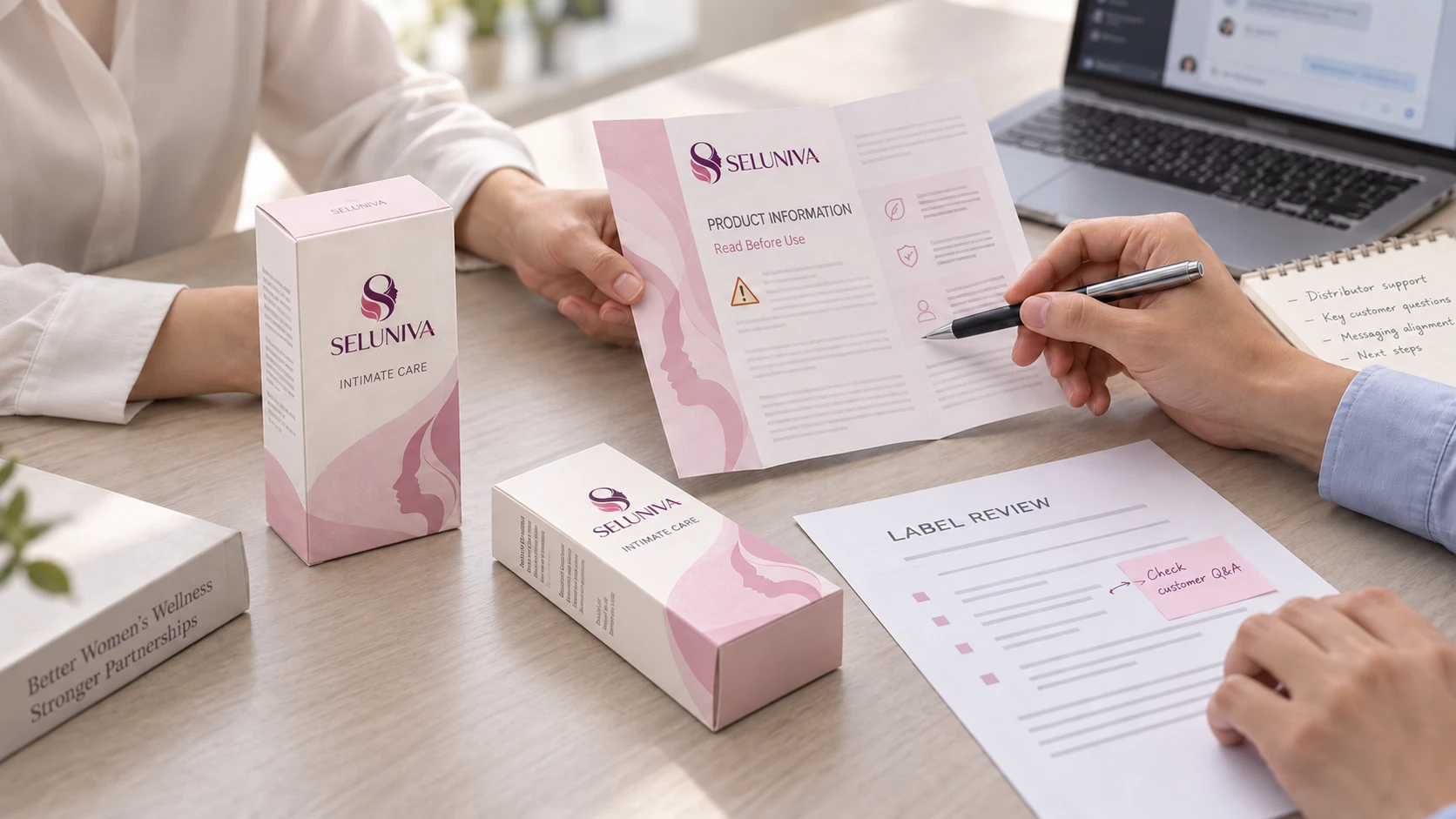
What is the private care capsule produced in Shaanxi: Positioning and form of SELUNIVA Yoni Pops (YP-3)
SELUNIVA Yoni Pops (model YP-3) is a vaginal capsule made with natural herbal plant extracts as raw materials. Its product form belongs to the vaginal suppository capsule category (Vaginal Suppository Capsules). It is inserted into the vagina during use and is positioned as a daily care product for cleansing, tightening, detoxifying, and nourishing, rather than an oral or topical application product. The shelf life is marked as 2 years, and the place of origin is Shaanxi.
This private care capsule is a daily care product, not a medical treatment
According to the product information, its functional description is concentrated on care-oriented language such as "cleansing, tightening, detoxifying, and nourishing," with no drug registration or therapeutic claims. This means two things:
- If you are looking for a treatment plan for specific gynecological symptoms, this product is not in that category and should go through medical channels;
- If you are looking for a product that can be incorporated into a daily care routine and whose herbal raw material positioning is acceptable to you, then it falls within your range of options.
Let's draw this boundary clearly first, so that the subsequent supply chain assessment is meaningful—because the compliance pathways, raw material requirements, and criteria for judging supply stability are all different for care products and medical products.
What are the differences in form between vaginal capsules, oral capsules, and suppositories?
All three may look like capsules in appearance, but their usage methods and design logic are different:
- Oral capsules: absorbed through the digestive tract, with the contents designed according to the gastrointestinal environment.
- Vaginal suppositories: after insertion into the vagina, they rely on body temperature or body fluids to melt and release, with the base and contents designed for mucosal contact scenarios.
- Vaginal capsules such as YP-3: The herbal extract is wrapped in a capsule shell and inserted into the vagina for use, belonging to a capsulated form based on the suppository concept.
For procurement or long-term use decisions, the key difference is that vaginal products have stricter requirements for raw material purity, capsule shell material, and microbiological indicators than oral products, as they are closer to mucosal contact standards. This is also why the information "produced in Shaanxi" cannot be seen merely as a geographical label—it actually points to a whole set of conditions including raw material origin, production environment, and supply radius.
What does the place of origin Shaanxi mean for the product?
Shaanxi is the labeled place of origin for this product, but the place of origin itself does not directly equal supply chain stability. What it provides is a verifiable starting point: whether raw materials are locally sourced, whether production is completed in the same region, and whether herbal raw materials have seasonal fluctuations. These are the actual variables that determine whether long-term supply is stable.
If what you care about is sustained supply capability, the next step is to confirm with the SELUNIVA team: the sourcing structure and procurement cycle of herbal raw materials, and how Shaanxi production capacity responds when order volumes change.
What procurement problems can Shaanxi-produced private care capsules solve: What does OEM/ODM and private label support mean
For brand owners without their own factories, the barrier to entering the private care category is often not "whether there is a product," but "whether it can be sold under their own brand." This Shaanxi-produced private care capsule from SELUNIVA supports OEM/ODM and private label, precisely targeting this step: without building your own production line, you can take on the private care capsule category.
What OEM/ODM and private label support means for brand owners
This support mainly solves three things: product sourcing, obtaining finished products without building your own factory;brand ownership, products can carry the buyer's brand rather than only being sold under the original SELUNIVA brand;speed of category entry, eliminating the setup cycle from formula to filling. For brand owners who want to validate the market first and then decide whether to invest heavily, this is a low-barrier starting path. The specific customization scope and timeline need to be confirmed with the product party.
Which procurement scenarios are suitable for starting with this product
- The brand wants to quickly launch a private care capsule SKU, and the formula and production require external support.
- The trader received an inquiry for private care capsules from an online pharmacy channel. The capsule form can match, but the channel qualifications and ingredient descriptions need to be prepared in advance.
- Institutional procurement wants to introduce daily private care products as a service supplement, and it is necessary to clarify the applicable population and risk warnings to reduce customer complaints.
Note: If cross-border sellers want to make private care capsules for private-label export, the country-of-origin labeling, ingredient statements, and target market compliance differences are still unclear. Whether export is supported and the labeling requirements need to be confirmed with the product party, and it is currently not advisable to make direct commitments.
Is the private care capsule supply chain produced in Shaanxi stable: four actionable evaluation dimensions
"Produced in Shaanxi" itself does not constitute evidence of stability or instability. The place of origin can only indicate that the production or raw material stage may fall within that region; it cannot replace an assessment of supply capacity. To assess whether SELUNIVA private-care capsules can be supplied over the long term, it is recommended to verify item by item from four dimensions: raw material transparency, communication mechanisms, model matching, and compliance boundaries.
Transparency of raw material sources: how to verify 100% natural herbs
The product is labeled as "100% natural herbs" and "natural plant extracts," but the batch consistency of herbal raw materials still needs to be confirmed. You can verify with the SELUNIVA team: whether the raw materials have fixed supply channels, whether extracts are retained as samples by batch, and whether the formula will be adjusted due to seasonal or origin changes. This information directly relates to the stability of ingredients between different batches.
Supply communication and long-term cooperation: which questions must be confirmed with the SELUNIVA team
Production capacity, delivery time, and minimum order quantity are information that needs to be confirmed with the supplier and should not be assumed as fixed values. It is recommended to ask clearly item by item: regular minimum order quantity, peak-season production scheduling cycle, the specific scope of OEM/ODM and private label customization, whether repeat purchase prices change with batch size, and the process for handling quality objections. At the same time, confirm export qualifications and labeling compliance requirements, because the labeling regulations of the target markets (the United States, Canada, Europe, Australia) differ.
Judgment boundary: If the other party can provide clear raw material traceability explanations, production scheduling cycles, and batch arrangements, and these match your sales rhythm, you can proceed to the sample or small-batch testing stage;if they can only give vague descriptions such as "produced in Shaanxi, natural herbal," then that is not enough to support a judgment about long-term supply.
Who this Shaanxi-produced private care capsule is suitable for and who it is not suitable for: procurement decision boundaries and next steps
This SELUNIVA YP-3 private care capsule is produced in Shaanxi, uses natural herbal extracts as raw materials, is positioned for vaginal cleansing, tightening, detoxification, and nourishment, has a shelf life of 2 years, and supports OEM/ODM and private labeling. To judge whether it is suitable for you, the core issue is not whether the "product is good," but whether your procurement goals are clear and whether you can provide channel and market information.
Recommended for: buyers with clear goals who can provide channel and market information
If you meet the following conditions, this product is worth prioritizing for evaluation:
- You already have clear sales channels for the intimate care category (such as vertical women's care channels, cross-border independent sites, or regional agents) and know who you want to sell to;
- You can clearly explain the compliance requirements and labeling standards of the target market and are willing to cooperate by providing channel information;
- You have private-label or customization needs and require supplier support for OEM/ODM;
- You have preliminary expectations for MOQ, lead time, and packaging format, and can accept confirming these conditions item by item.
The common trait of this type of buyer is: the boundaries of demand are clear, and the supplier only needs to match on herbal ingredients, capsule form, and private-label capabilities, resulting in low communication costs and stable ongoing maintenance.
Not recommended for: scenarios with unclear goals, insufficient information, or frequently changing expectations
It is not recommended to increase the procurement complexity of this product now in the following situations:
- The target market has not yet been determined, or the compliance requirements of different markets vary greatly but have not been sorted out;
- Channel, sales volume expectations, or packaging preferences cannot be provided, making it impossible to lock in the minimum order quantity and quotation;
- The expected results change frequently, for example, today you want to do a detox concept, and tomorrow you switch to a firming positioning, making it difficult for suppliers to provide a stable solution;
- You only want small-batch spot goods to test the waters, but you require private label customization—the cost structures of these two are different, and discussing them together easily leads to repeated back-and-forth.
In these scenarios, the problem is not the product itself, but that the requirements have not yet converged. At this point, adding one SKU will only amplify communication and inventory risks.
The trade-off between budget and complexity
The cost of this product does not come from the unit price alone. Private labeling involves packaging design, label compliance, and minimum order quantity thresholds;Long-term supply also involves the stability of raw material batches and delivery times. If you only need to solve one clear main problem (for example, adding a herbal private-care capsule to an existing channel), the current solution is suitable;If you need a more complete product line, higher collaboration complexity, or a long-term maintenance commitment, you should first confirm whether these conditions are within the supplier's capabilities before deciding whether to proceed.
Next steps
First confirm three things with the SELUNIVA team: your target market and channel, the level of private labeling needed, and the acceptable minimum order quantity and delivery time. Once these three items are clear, then discuss pricing and samples, and your judgment will be much clearer.
Frequently Asked Questions
Is this capsule a medicine or a care product? The product is positioned as a daily intimate care product, made with natural herbal extracts as raw materials, and is not a medicine. The specific claim boundaries need to be confirmed in accordance with the regulations of your target market.
Do you support private labeling? What is the minimum order quantity? OEM/ODM and private labeling are supported, but the minimum order quantity and packaging customization scope need to be confirmed with the SELUNIVA team; different levels of customization correspond to different thresholds.
The shelf life is 2 years. Can long-term supply make batch consistency more reliable? Shelf life is a product attribute, and the batch stability of long-term supply depends on raw material procurement and production scheduling. It is recommended to raise specific requirements regarding delivery time and batch consistency with the team before cooperation.
I only want to do small-batch trial sales. Is this product suitable? If you only need spot goods for trial sales and do not involve private labeling, you can first confirm whether there is a small-batch option;If private label customization is also required, the cost and threshold will rise significantly and need to be reassessed.
Learn more
If you are evaluating a private label project for intimate care capsules, you can organize your target market, channel type, required level of private labeling, and acceptable minimum order quantity and delivery time, and send them to the SELUNIVA team.Based on this information, we will help match formulas, capsule shells, packaging, and labeling solutions, and provide a path forward for samples and small-batch testing.
Related products: Private Label SELUNIVA Yoni Detox Pops Cleaning Pills Organic Vaginal Tightening Suppositories Boric Acid Capsule