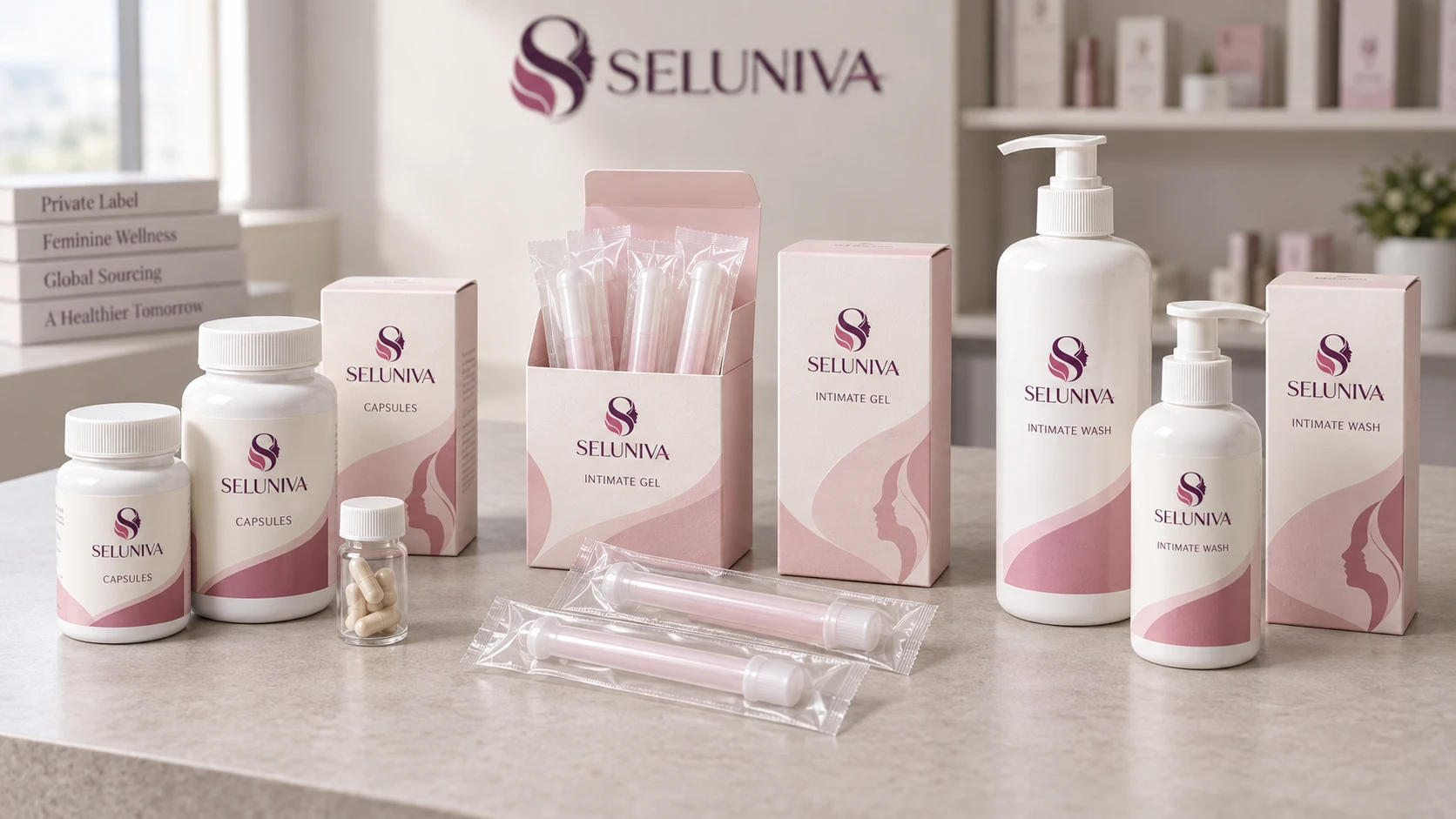
What roles do capsules, gels, and washes each play in the intimate care routine?
Putting these three types of products on the same shelf easily makes people think they are substitutes for one another, as if you just need to pick one. But from the perspective of how they are used, they are not solving the same problem at all.
Why the three forms cannot be treated as similar products that replace one another
Washes act on the vulva and external areas and belong to the cleansing step; they are rinsed off after use, so they stay on the body surface for only a very short time. Gels are usually topical application types, covering the external area or near the entrance, and tend toward daily maintenance such as soothing and lubrication. Insertable capsules are different—they need to be placed inside the vagina, where they remain in the body, dissolve, and release their contents; both their site of action and their residence time are on a different level from the previous two.
In other words, washes and gels take care of the "outside," while capsules take care of the "inside." Using a wash to replace capsules is like only cleaning at the doorway and never getting into the room;Using capsules to replace a wash, on the other hand, is treating internal care as external cleaning, which is a misalignment in the process.
What the insertable capsule positioning of SELUNIVA Yoni Pops (YP-3) means
The model of SELUNIVA Yoni Pops is YP-3, the product type is labeled as Vaginal Suppository Capsules, the method of use is stated as "insert into the vagina, use as cleansing and firming capsules," and the ingredients are natural herbal plant extracts. These points determine its place in the care routine: it belongs tointernal care steps, not cleansing or topical application steps.
For those pairing SKUs, this means the relationship among the three is one of sequence and internal-external division of labor in the process, rather than a choice between competing products of the same type. In a complete intimate care routine, external cleansing (wash), external maintenance (gel), and internal care (capsules) can each occupy one step;But if you only plan to offer one category, you must first clarify whether you are serving 'external cleansing needs' or 'internal care needs,' as the purchase motivations and repurchase logic of these two user types are not the same.
As for which groups the capsules are specifically suitable for and how to arrange the frequency of use, this depends on the user's physical condition and care goals. This part requires confirming a matching plan with the SELUNIVA team based on the actual situation, rather than inferring from the form itself.
Building an SKU combination with SELUNIVA capsules as the core can solve what product selection problems?
The difficulty in product selection for the intimate care category is often not finding a single product, but that a single product cannot support the user's complete care cycle. SELUNIVA Yoni Pops (YP-3) is a vaginal herbal capsule positioned for cleansing, tightening, detoxifying, and nourishing, with a shelf life of two years. Building a combination with it as the core solves exactly the problem of 'users have continuous care needs, but your shelf only offers a one-time choice.'
The differentiated value of insertable capsules in the intimate care category
In the intimate care market, gels and washes are more common, while insertable capsules are relatively rare. The way capsules are used determines that they are closer to "cyclical care" rather than "daily cleansing." Once users accept this format, they often need to repurchase on a cyclical basis. Putting YP-3 at the center of the combination is equivalent to using a product with a clear usage rhythm to drive peripheral categories such as gels and washes—washes handle daily care, gels handle transition, and capsules handle cyclical deep care.
Users do not have to piece together solutions across different brands, and you do not have to rely on a single hit product to repeatedly acquire new customers.
The impact of OEM/ODM and private label support on combination strategy
SELUNIVA supports OEM/ODM and private label, which means the combination does not have to stop at "packaging existing products together for sale." You can adjust the specifications, packaging, and naming of capsules and supporting products around your own brand positioning, making the entire SKU set look like a complete solution rather than several unrelated individual items. For product selectors, this directly affects two things: first, whether the gross margin structure of the combination can be controlled by yourself; second, whether subsequent restocking and iteration are constrained by the supplier's fixed catalog.
What care needs can combination SKUs cover?
- Daily cleansing and moisturizing: paired with a wash or gel, addressing high-frequency usage scenarios
- Periodic deep care: centered on YP-3 capsules, creating an anchor for repeat purchases by cycle
- Firming and nourishing needs: covered by the functional positioning of the capsules themselves
- Gift box or set scenarios: multi-category combinations are more suitable than single items for presenting as a complete solution
If you only sell single items, users buy and leave, and it is hard to tell whether they are satisfied or indifferent;Combination SKUs, however, can reveal through the cross-category attachment patterns whether users truly care about cleansing, firming, or nourishing, providing a basis for future product selection.
What needs to be confirmed is: whether your target users accept the insertable capsule format, and how many days your planned care cycle is. These two points will directly affect the ratio of gel and wash in the combination. For specific specifications and private label minimum order conditions, it is recommended to communicate directly with the SELUNIVA team to match a solution.
Which channels and scenarios are suitable for the combination of capsules + gel + wash, and which are not?
Whether the combination SKU can be established depends on whether the channel can clearly explain the division of labor among 'internal insertion + external use + daily cleansing.'
Differences in combination suitability for online pharmacies, retail pharmacies, and private domain communities
Online pharmacy users search with clear questions, have short browsing paths, compare prices quickly, and make decisions based on detail pages and reviews. Combination SKUs require the page to simultaneously explain the usage order and division of labor among capsules, gel, and wash;If the detail page can only explain a single product, the combination instead lengthens the decision chain. A more prudent approach is to launch individual products first, and only consider bundling once pairing needs emerge in reviews and Q&A.
Retail pharmacies and private-domain communities offer opportunities for face-to-face or quasi-face-to-face communication—staff can explain the order of use, and the community can provide ongoing answers to questions. The value of a bundle lies in "sequence and division of roles." Only when someone can explain it clearly will users dare to buy the full set at once. Private-domain channels are especially suitable because repurchase cycles and feedback can be tracked. Whether the bundle is actually used and which item is finished first can both become the basis for the next round of adjustments.
In what situations is an individual product plan more reasonable than a bundle?
When the user's goal is singular—they only want cleansing, or they only care about firming—the other two items in the bundle become a burden. When users are still unfamiliar with the category and are still trying their first item, it is also not suitable to introduce three items at once. If the channel itself lacks the ability to answer questions, no one conveys the pairing logic of the bundle, and users do not know which item to use first after receiving it. In that case, individual products are more likely to deliver visible results.
In cross-border export scenarios, combo packs may trigger different declaration and labeling requirements in different markets, and the complexity of packaging, ingredient labeling, and usage descriptions will all increase. These are not compliance conclusions, but specific conditions that need to be confirmed with the SELUNIVA team: whether combo SKUs support market-specific customized packaging, who provides the label copy, and whether individual items in the set can be restocked separately.
The boundary for judgment can be summarized as: if someone can clearly explain the pairing logic and users have an expectation of continued use, the combo is suitable;if the channel can only rely on the page to explain itself and the user's goal is still very singular, then start with a single product.
How do you determine whether to choose a complete combo or start with a single product?The key is to look at these three decision points
A combo is not "listing a few more SKUs to sell a few more units," but rather running three product lines at the same time. If you cannot answer even one of the following three decision points, start with a single product.
How should target users, channel qualifications, and subsequent maintenance capabilities be evaluated?
Whether the target users converge into the same type of person. If the user profile is still a broad description like "women concerned about intimate care," capsules, gels, and washes actually correspond to three different types of needs, and the combination becomes three product lines each having to educate the market separately. Only when the same group of users proactively asks "what should be used together with it" does the combination have a foundation for synergy.
Whether channel qualifications and ingredient descriptions are in place. YP-3 is a capsule for intravaginal use, and channels such as online pharmacies have higher requirements for ingredient descriptions and risk warnings. If qualifications have not been fully cleared, launching the combination directly will amplify the risk of customer complaints.
Only when the channel already has mature review experience will the marginal cost of the combination decrease.
Whether the follow-up maintenance capability can keep up. A combination means three sets of inventory, detail pages, and after-sales Q&A. When the team's manpower is limited, a single-product plan is more controllable.
The relationship between the parameters of SELUNIVA Yoni Pops (YP-3) and combination decisions
Known parameters: brand SELUNIVA, model YP-3, type Vaginal Suppository Capsules, shelf life 2 years. The attribute of intravaginal use determines that its decision-making threshold is higher than that of external washes, making it suitable as a core SKU for building trust in a combination rather than as a traffic-driving item. The specific customization scope and supply capacity need to be confirmed with the SELUNIVA team.
Conclusion: If you can clearly explain why the same group of users needs a second form factor, then proceed with the combination;if you can't explain it clearly, start with a single product first. When two or more of the target users, channels, and maintenance capabilities are uncertain, a combination brings three times the uncertainty rather than synergy.
Frequently Asked Questions
Can YP-3 serve as the first SKU on its own? Yes. Its specifications are sufficient to support an independent product line, provided that the instructions for intravaginal use and user education are done thoroughly.
What signals indicate that users are ready to take on a combination? Existing users proactively ask about companion products. If no one asks, it means demand hasn't reached that stage yet.
If channel qualifications haven't been fully validated, what happens if you launch a bundle first? When ingredient descriptions and risk warnings are insufficiently prepared, customer complaint risk will amplify with the number of SKUs. It is recommended to first validate the compliance path for a single product.
How should the budget boundary for a bundle be determined? Additional investment should be supported by confirmed repeat purchase demand, not expected demand. Before demand is confirmed, a single product is a safer boundary.
Learn more
If you are evaluating product selection directions in the intimate care category, you can start by confirming the target user's care needs—whether it is primarily external cleansing or requires periodic internal care.SELUNIVA Yoni Pops (YP-3) supports OEM/ODM and private labeling. You are welcome to submit your target market, channel type, and expected care cycle, and we can help match a combination plan and customization scope accordingly.
Related products:Private Label SELUNIVA Yoni Detox Pops Cleaning Pills Organic Vaginal Tightening Suppositories Boric Acid Capsule