For the customization of private-label intimate care capsules, first distinguish between "product facts" and "items to be confirmed"
Which information about SELUNIVA Yoni Pops intimate care capsules (YP-3) is certain
Based on existing product information, the following information belongs to established product facts: the brand is SELUNIVA, the model is YP-3, the place of origin is Shaanxi, the type is Vaginal Suppository Capsules, the ingredients are 100% natural herbal plant extracts, the method of use is vaginal insertion cleansing and tightening capsules, and the shelf life is 2 years. These are established product-level details that do not change with customization requirements and can serve as a common premise for subsequent discussions.
Why the modifiable scope of the formula, capsule shell, packaging, and labels cannot be generalized
The formula, capsule shell, packaging, and labels belong to different decision-making levels, each involving different adjustment costs and confirmation processes. Formula adjustments may affect capsule formation and stability;The capsule shell involves physical specifications;Packaging and labeling are subject to the compliance requirements of the target market. Therefore, there is no uniform answer for the customization scope of intimate care capsules. The adjustable scope depends on the cooperation model (OEM/ODM) and the regulations of the target market, and must be confirmed item by item with the product supplier.
The goal of this article is to help you create a checklist of customization requirements that can be verified item by item, rather than promising specific adjustable items.
Can the formula be changed? First look at the ingredient positioning and how to choose between OEM/ODM models
Whether the formula of intimate care capsules can be adjusted depends on the space provided by the ingredient positioning and whether you choose OEM or ODM.
What factors may constrain the room for formula adjustment when 100% natural herbal plant extracts are used?
The ingredients of this SELUNIVA product are labeled as 100% natural herbal plant extracts. This statement itself constrains formulation actions: adding synthetic ingredients or non-plant-derived additives would conflict with the positioning of "100% natural herbal." Herbal compound formulas also involve a balance of ratios among extracts. Changing the amount of one ingredient may affect scent, color, and stability, so it is not a simple substitution.
Therefore, formula adjustments usually focus on the variety, ratio, or extraction specifications of herbal raw materials. Exactly which ones can be substituted, and whether the replacement still fits the original positioning, must be confirmed item by item based on the target market's acceptance of herbal ingredients.
Under OEM and ODM models, who holds formula leadership respectively?
The core difference is "who sets the formula":
| Model | Formula leadership | Applicable situations |
| OEM | The brand provides or specifies the formula, and the factory produces on demand | Has a mature formula and can bear compliance and stability responsibilities |
| ODM | The factory provides an existing formula, and the brand applies its own label | Has no proprietary formula and wants to scale up quickly |
Under the ODM model, the room for adjustment is usually limited to what the factory is willing to open up; the deeper the changes, the closer it comes to redevelopment.
Regardless of the mode, formula adjustments require confirmation of ingredient safety, target market compliance requirements, and batch consistency. Natural herbs do not equal risk-free; ingredient safety and irritation potential must be based on the materials provided by the product owner, and this cannot replace medical treatment.
What can be changed about the capsule shell and packaging?First distinguish between "form constraints" and "brand expression."
When making private-label intimate care capsules, the parts that can be changed beyond the formula mainly fall into two areas: the capsule shell and the packaging. However, the degree of adjustability in these two areas is not the same—the capsule shell is constrained by the product form, while packaging is closer to pure brand expression.
For vaginal insert capsules, what limits the adjustment space for shell material and size?
SELUNIVA's Yoni Pops are vaginal suppository capsules, with contents made from natural herbal plant extracts. The capsule shell for this type of product must first meet the basic requirements of "being able to be inserted smoothly and disintegrating in the body as expected," so the shell material and size cannot be changed at will:
- Shell material: Commonly there are two types: gelatin or plant-based sources (such as HPMC hydroxypropyl methylcellulose).Whether it can be changed from gelatin to a plant-based shell depends on the compatibility between the contents and the shell material, the disintegration performance, and the target market's acceptance of animal-derived ingredients.This point needs to be confirmed with the team regarding the current shell material type and available alternatives.
- Size: The specifications of insertable capsules are usually concentrated in a few models, and size changes directly affect the user experience.Changing to a larger or smaller size is not simply a matter of changing molds; it also requires re-verifying whether the disintegration and the fill volume of the contents match.
In other words, the capsule shell belongs to the "form constraint" layer: it can be discussed, but every adjustment must return to the three conditions of "insertion safety + disintegration behavior + content compatibility." If your private-label needs are only about changing the brand or changing the market, you usually do not need to change the shell;Only when the target market is sensitive to animal-derived ingredients, or when user feedback indicates that the usage experience needs adjustment, is it worth raising the shell material and size as a topic.
Packaging is divided into several layers from the inside out; which layers are more suitable for private labeling?
The customizable space for packaging is clearly greater than that of the capsule shell, and it is roughly divided into three layers from the inside out:
- Direct contact layer: the inner bottle/inner bag/blister that holds the capsules.This layer must balance sealing, moisture resistance, and shelf life (this product is labeled with a shelf life of 2 years). The customizable space is limited, usually mainly in material and sealing method, and there is little printing space.
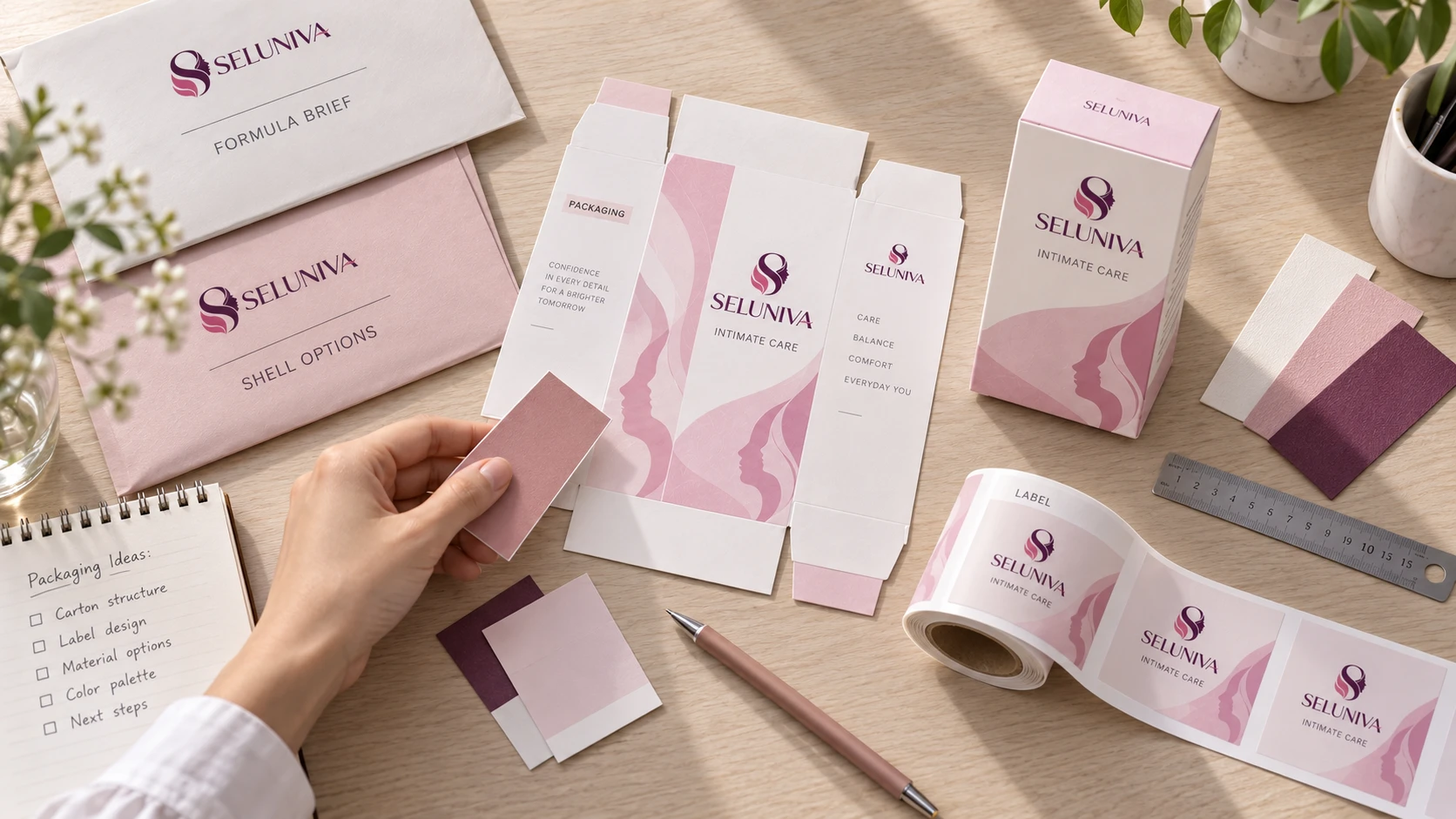
- Sales unit layer: a single retail box or bottle label.This is the most core layer of private labeling—the brand name, logo, main visual, ingredient and usage instructions, and legally required labeling information all go here, and it is also the part consumers see at first glance.
- Transport and assembly layer: outer cartons, inner boxes, instruction cards, etc.It is suitable for creating an unboxing experience and extending brand tone, but its priority is lower than the sales unit layer.
If the budget is limited, it is recommended to concentrate customization resources onSales unit layer: it directly determines shelf recognition and whether compliance information is complete. The direct contact layer should focus on "no changes, more reliable functionality";the transport layer can be deferred.
It should be noted that the ingredient, usage, and efficacy statements on the packaging must be consistent with the actual product and comply with the labeling regulations of the target markets (the United States, Canada, Europe, Australia). Which words can be used and which cannot should be confirmed item by item with the team before finalizing the text, rather than designing first and remedying later.
Next-step confirmation checklist: whether the existing capsule shells are gelatin or plant-based, and what alternative options are available;the specific requirements of the target markets for shell materials and labeling;the minimum order quantity and sampling lead time for the sales unit layer. Get these three points clear before deciding which parts are worth investing in private label customization.
What can be changed on the label? Compliance boundaries are more worth confirming first than design freedom.
For private label private care capsules, label customization changes brand expression, not the facts themselves. The brand name, logo, visual design, and language version can usually be adjusted to your needs, but mandatory labeling items such as ingredients, country of origin, shelf life, and directions for use must comply with the target market regulations and cannot be omitted or rewritten.
Which information on a private label label is considered mandatory labeling content?
Requirements vary by market, but private care capsule labels usually cannot avoid these categories: product name and intended use positioning, ingredient list, net content or specifications, production batch number and shelf life, manufacturer or responsible entity information, and necessary instructions for use and safety warnings. These are compliance bottom lines; what private label can change is the presentation, not deleting or rewriting the facts. It is recommended to confirm the specific format with the product team before proofing.
Why efficacy claims cannot be written arbitrarily, and where the boundary lies between daily care products and medical treatments
SELUNIVA Yoni Pops intimate care capsules are positioned as daily care products, made with natural herbal plant extracts as raw materials, with Shaanxi as the place of origin and a shelf life of 2 years. Labels for daily care products generally cannot contain claims of treating, curing, diagnosing, or preventing diseases, nor can they imply that they can replace drugs or medical procedures. Whether and how terms such as "cleansing," "nourishing," and "firming" can be used depends on the regulatory requirements of the target market and cannot be generalized.
It is recommended to submit candidate copy to the product team in advance for a compliance assessment, rather than printing first and revising later.
Frequently Asked Questions
Q: What content on the labels of private-label intimate care capsules can be changed? Brand name, logo, visual design, and language version are usually adjustable;Mandatory labeling items such as ingredients, country of origin, shelf life, and instructions for use must comply with the regulations of the target market and cannot be omitted at will.
Q: What information on the label is considered mandatory? Generally, this includes the product name and purpose, ingredient list, net content, batch number and shelf life, responsible entity information, and necessary safety warnings, subject to the specific requirements of the target market.
Q: What cannot be written in efficacy claims? Claims about treating, curing, diagnosing, or preventing diseases cannot be written, nor should they imply a substitute for medical treatment. Whether daily care descriptions can be used must be judged in light of the target market's regulations.
Q: How can you confirm whether a labeling plan can be used? Organize your target market, product positioning, and candidate copy, and confirm the label compliance matching plan with the SELUNIVA team before sampling—this is more reliable than judging on your own.
Learn more
If you are planning a private-label private-care capsule project, you can first organize your target market, preferred cooperation model, and a list of the steps you want to adjust, then contact the SELUNIVA team to confirm the customizable scope and sampling arrangements item by item.Asking questions upfront saves more time than designing first and fixing later.
Related products:Private Label SELUNIVA Yoni Detox Pops Cleaning Pills Organic Vaginal Tightening Suppositories Boric Acid Capsule