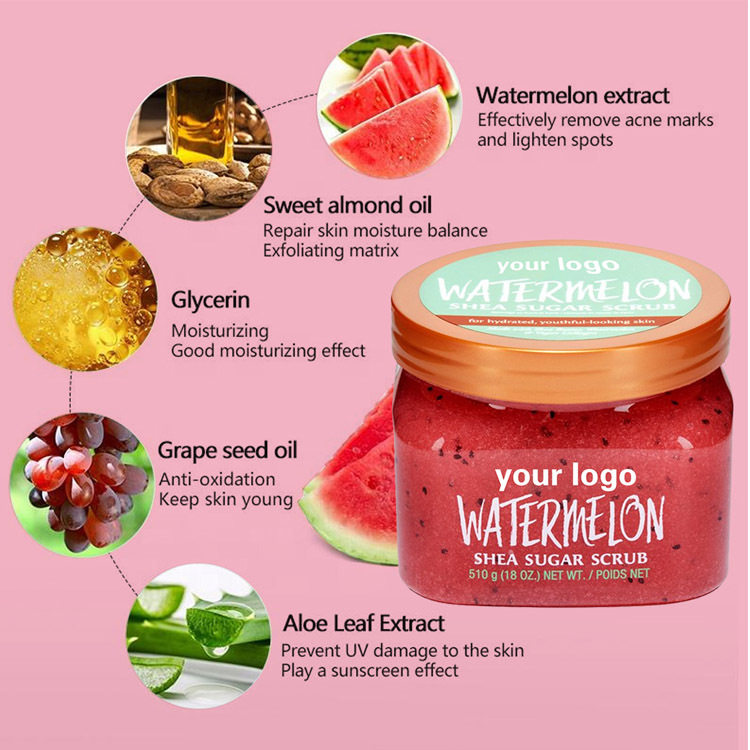
What is SELUNIVA BS-2 Watermelon Body Scrub: Product Facts and the Starting Point of Conflict with the Age Group: Children Label
SELUNIVA BS-2 is a watermelon-scented exfoliating body scrub, belonging to the SELUNIVA body care series. The product model is BS-2, with a single jar capacity of 510g, using large jar packaging, produced in Shaanxi, used by massaging onto wet skin and then rinsing off, positioned for home use.
Which fields in the product information are facts that can be directly cited
From the existing product information, the fields that can be confirmed include:
- Brand: SELUNIVA
- Model: BS-2
- Capacity: 510g
- Scent: Watermelon fruit scent
- Origin: Shaanxi, China
- Usage method: Massage onto wet skin, then rinse
- Function Description: Exfoliates, deeply cleanses, and is labeled as helping to prevent muscle cramps and soreness
- Form: Nourishing cream
- Usage Scenario: Home use
Among these fields, brand, model, capacity, place of origin, and method of use are objective information that can be directly cited. The statement "helps prevent muscle cramps and soreness" in the functional description is a functional claim in the product materials, and when communicating externally, it is necessary to determine whether it can be used directly in light of the compliance requirements of the target market.
Where is the conflict between Age Group: Children and the positioning for adult body care?
There is one field in the product materials that deserves special attention:Age Group: Children. This is clearly inconsistent with the product's positioning for adult body care.
The conflict is mainly reflected in three aspects:
First, the usage scenario does not match. The product is used by "massaging onto wet skin and then rinsing off," which makes it a body scrub product. Scrubs remove dead skin cells physically or chemically and are relatively common in adult body care, but children have a thinner skin barrier and lower tolerance, so whether scrub-type products are suitable for them needs to be evaluated separately.
The product information does not specify the particular method of use, frequency, or precautions for children for this product.
Second, the functional description is inconsistent with the positioning for children. The product function is labeled as "helps prevent muscle cramps and soreness," which is closer to post-exercise care or body relaxation scenarios for adults rather than daily care needs for children. If the Age Group is labeled as Children, then the target audience for this functional description becomes ambiguous.
Third, the target audience is inconsistent with the labeling. The product name includes descriptions such as "Organic Fruit Whitening Deep Cleanse," and the capacity is a large 510g jar; these features are more consistent with the purchasing and usage habits of adult body care. There is a lack of consistency explanation between the Age Group: Children labeling and the overall product positioning.
This conflict is not a minor issue at the textual level. It directly affects two judgments:who exactly this product is sold to, andunder what identity it is sold in the target market. If the Age Group is labeled as Children, but the product is actually promoted as an adult body scrub, then problems may arise in compliance review, platform classification, and consumer expectation management.
Currently, the materials do not provide specific evidence for the product's use by children, nor do they explain the source and purpose of the Age Group field. To determine whether this label is an entry error, an internal classification habit, or whether there is indeed a scenario for children's use, the following information needs to be confirmed with the SELUNIVA team:
- Age Group: Children is a classification requirement for which market?
- Does this product have any usage instructions or restrictions for children?
- Does the "prevent muscle cramps and soreness" in the function description apply to the labeled age group?
- When selling in the target market, should the product be declared under adult or children's care category?
Before this information is clarified, the conflict between Age Group: Children and the adult body care positioning will persist, and it will also affect subsequent compliance judgments and market communication strategies.
Can body scrub be labeled for children's use: What does Age Group: Children need to be clarified in the target market?
In the product information for SELUNIVA Watermelon Exfoliating Body Scrub (Model BS-2, 510g), the Age Group field is filled in as Children. This field is often treated as an ordinary attribute and directly carried over in the procurement and listing process, but it is actually closer to a compliance claim that needs to be verified, rather than a descriptive copy line.
Why the Children label cannot be directly understood as suitable for children
Age Group: Children only indicates that this is how the information was filled in; it does not mean the product has completed the corresponding assessment as a children's cosmetic. The determination of a children's product usually depends on formula irritation, the preservative system, fragrance dosage, method of use, and the age segmentation for "children" in the target market. This product is a scrub-type exfoliating product, and its method of use is to massage and then rinse off. It inherently involves physical friction and a rinse-off scenario, which is not naturally consistent with the conditions of use for infants or young children.
Therefore, this label needs to clarify at least three things: which age group it refers to, what testing or assessment it is based on, and whether it covers the scrub product form. Before a clear answer is obtained, it should not be treated as an external conclusion that it is "suitable for children."
Which compliance positions need to be confirmed with suppliers for the U.S., Canadian, European, and Australian markets
The four markets have different regulatory pathways for cosmetics and children's products. It is recommended to confirm item by item directly with the current website team rather than inferring on your own:
- United States: Whether children's cosmetics have undergone safety assessments in accordance with relevant FDA requirements, and whether labels need child-specific warning statements.
- Canada: Whether the requirements of Health Canada for cosmetics are met, and whether child-related claims require additional supporting materials.
- Europe: Whether the cosmetic safety report has been completed, and whether suitability for children is covered in the exposure scenarios of the safety assessment.
- Australia: Whether the introduction declaration has been completed in accordance with AICIS requirements, and whether children's use is within the scope of the assessment.
At the same time, it is necessary to confirm the specific age range corresponding to "children" and whether that range is consistent with the actual usage recommendations for the scrub product. These definitions will directly affect the compliance boundaries of listing copy, age labels, and advertising placement.
What impact does labeling Children have on market positioning: which channels and scenarios are not recommended to be directly carried over
A 510g large-jar body scrub is usually understood on adult body care shelves as a "family size" or "periodic care size"—large capacity, sufficient for a single use, and suitable for weekly body exfoliation. This positioning naturally corresponds to scenarios of adult personal use, family shared use, or multi-person sharing. However, the Age Group marked as Children in the product information will directly change the adaptation logic for channels and content scenarios.
The matching logic between the 510g large jar and adult body care channels
From the perspective of capacity and usage, 510g combined with the usage method of "massage onto wet skin and then rinse off" is closer to the regular rhythm of adult body care: a larger amount per use, wide coverage, and suitable for bathroom scenarios. Adult body care channels (such as body care sections, family-size shelves, and adult personal care e-commerce listings) usually organize information by "body part + benefit + volume" rather than grouping by age. Therefore, placing the 510g large jar in adult body care channels is consistent in terms of volume and usage.
The problem lies in the Age Group item. If it appears directly in adult channels as a listing attribute or packaging information, it will conflict with the channel's default audience: shelves and search scenarios are by default aimed at adults, while the label points to children. Consumers may easily wonder "who is this for?" while browsing, which in turn affects clicks and conversion judgments.
Which channels and content scenarios are not suitable for directly using the Children label
The following scenarios are not recommended to directly continue using the Children label unless the actual meaning and scope of application of the label are first confirmed with the SELUNIVA team:
- Adult body care shelves and sections: The product selection logic, display language, and promotional messaging of this channel all revolve around adult personal use or family sharing. The Children label will make the product appear mispositioned on the shelf.
- E-commerce listing main image and title for adults: When adult consumers search for "body scrub," the default expectation is an adult product.The appearance of a Children signal in the main image or title will reduce the degree of match with search intent.
- Family pack, multi-person shared-use content scenarios: The family pack positioning implies shared use by adult family members. A Children label will create additional explanation costs regarding "whether it is suitable for the whole family to use," while the existing materials do not provide specific conditions for children's use.
- Social media and content seeding with adults as the audience: If the content scenario is aimed at adult body care, the Children label requires additional explanation to be self-consistent; otherwise, readers will be confused about exactly whom the product is designed for.
The key point that needs clarification is: Is the Age Group labeled as Children the actual applicable age of the product, or is it just the standard used when filling out the materials? These two situations have completely different impacts on channel selection. If it is actually intended for adults and only the labeling in the materials needs correction, then the channel fit issue can be resolved by updating the listing attributes;if the product is indeed intended for children, then the match between the 510g large jar and children's usage scenarios, as well as its suitability for adult channels, both need to be reassessed.
It is recommended to confirm with the SELUNIVA team regarding the basis for the labeling, the target user group, and the channel strategy before deciding whether to proceed.
How to clarify the Children labeling with the supplier and make a final positioning decision: question list and conclusion boundaries
The product materials list Age Group as Children, while the actual target audience for this SELUNIVA watermelon body scrub (BS-2, 510g) is adults seeking body exfoliation. If this contradiction is not resolved, subsequent pricing, packaging copy, and channel selection will all go off track. You need to ask the supplier the following questions clearly before deciding whether to continue moving forward.
Confirm with SELUNIVA or the supplier the specific list of questions regarding Age Group: Children
- Is this label a typo or intentional? Was it a default option when filling out the form, or was the product actually filed or declared under the children's category?
- Are the formula, fragrance concentration, and exfoliating particle size of BS-2 designed according to children's product standards? If it is just an adult formula that was mislabeled, then subsequent promotion and sales should not continue to use this positioning.
- In the existing materials, besides the Age Group column, which other documents, labels, or system records say Children? We need to know how large the scope of changes is.
- If it is changed to adult positioning, does any product description or label need to be reissued? This determines whether the modification cost is just a few lines of text or an entire batch of materials.
- What kind of usage scenarios was the 510g large can originally intended for? Children's products typically do not use this specification, and this contradiction itself may be the basis for judgment.
In what situations it can be carried over, in what situations it must be modified, and in what situations it is not worth continuing to pursue
There are very few situations where the Children label can be carried over: It only holds when the supplier can clearly state that the product is indeed designed for the children's body care category, and you also intend to enter the children's care channel. Even so, using scrub-type products for children itself requires more cautious evaluation and cannot be decided based on just one field.
Situations that must be modified: The supplier confirms it was a form-filling error, the formula and specifications are designed for adults, and your target market is the adult exfoliation demand in the United States, Canada, Europe, or Australia. In this case, the Children label is a documentation error, and continuing to use it will directly mislead channels and consumers.
Situations not worth pursuing further: If the supplier cannot explain the source of this label, or insists on the Children positioning but cannot provide the corresponding formula and compliance basis, and at the same time you do not plan to enter the children's category—then the communication cost of this product positioning has exceeded the value it can bring. At this point, you should pause rather than list it first and fix it later.
Frequently Asked Questions
Q: The supplier says Children is just a system default value. Can I simply ignore it? You cannot simply ignore it. As long as this field remains in external materials, channel partners and consumers may see it.
The supplier needs to confirm in writing that it is an incorrect label and specify the revised version.
Question: If I only target the adult market, will the Children label affect sales? Yes. Incorrect age positioning will make channel partners question your product qualifications and may also trigger platform reviews of age labeling.
Correct it first, then move forward.
Question: Does changing this label require retesting or recertification? It depends on the supplier's actual documentation. If it is only an error in internal document fields, the cost of modification is low;if it has already been used on labels or for declarations, you need to ask clearly whether the documents must be reissued.
This point must be confirmed with the SELUNIVA team; do not make assumptions on your own.
Question: Under what circumstances should I give up on this product? When the supplier cannot clearly explain the source of the labeling and cannot provide a clear basis for the adult positioning, and your target market is adult care—when these three conditions are all true at the same time, the complexity of continuing to push forward is not worth it.
Learn more
If you are evaluating private label cooperation for this watermelon body scrub, it is advisable to first confirm the ins and outs of the Age Group labeling clearly.You can organize your target market, channel type, and desired age positioning for the SELUNIVA team, and we will assist you in checking the materials item by item to determine whether to proceed after correcting the labeling or whether the product positioning needs to be reevaluated.
Related products:Watermelon Exfoliating Body Scrub Organic Fruit Whitening Deep Cleanse 510g Large Jar Private Label